Your support is needed and is appreciated as Amigaworld.net is primarily dependent upon the support of its users.

|
|
|
 22 crawler(s) on-line. 22 crawler(s) on-line.
 95 guest(s) on-line. 95 guest(s) on-line.
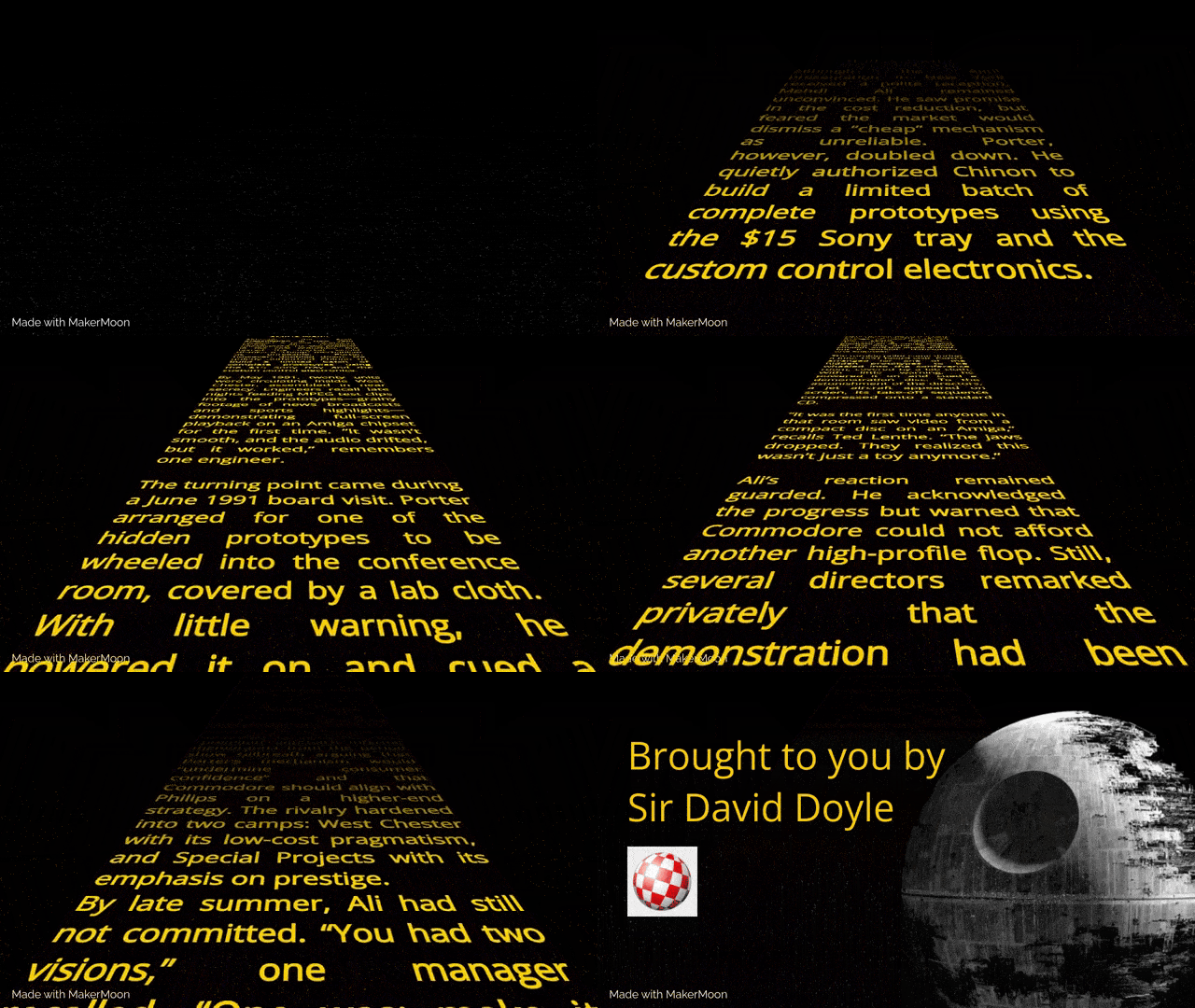
 0 member(s) on-line. 0 member(s) on-line.
You are an anonymous user.
Register Now! |
|
|
|
| Poster | Thread |  cdimauro cdimauro
|  |
Packed/chunky/C2P
Posted on 8-Sep-2025 5:42:27
| | [ #1 ] |
| |
 |
Elite Member
 |
Joined: 29-Oct-2012
Posts: 4584
From: Germany | | |
|
| Continuing the discussion from here: https://amigaworld.net/modules/newbb/viewtopic.php?mode=viewtopic&topic_id=45508&forum=16&start=500&viewmode=flat&order=0#880976
@Hammer
Quote:
Hammer wrote:
@cdimauro
Quote:
OK, but that wasn't my point. The context was the CDTV and its market, which is more like a multimedia player / kiosk, and with the ability to run Amiga games (but it wasn't central).
Chunky/packed wasn't needed for that, neither a hardware conversion logic.
|
Hardware C2P improves PC ports handling. |
Which was NOT the scope of the CDTV, as I've tried to explain.
Quote:
Games such as Grind/Dread have extra R&D effort with Blitter-assisted C2P.
A500-level hardware has crap Death Mask instead of Grind/Dread.
There are three pathways for chunky pixels:
1. Chunky graphics hardware support. Result: zero R&D risk for 3rd party developers.
2. Hardware C2P. Result: reduced R&D risk for 3rd party developers.
3. Blitter-assisted C2P. Needs game-ready SDK code sample to reduce R&D risk for 3rd party developers. Executing "Michael Abrash" level evangelism for VGA's Mode X for Blitter-assisted C2P. Remove software C2P is slow statement in all official documentation since this is self-defeating. |
Only the first one made sense and it was also cheap to implement, having the right knowledge of the chipset AND vision.
Quote:
| During the early 1990s, for each independent game project, 3rd party developers had to reinvent the wheel on Blitter-assisted C2P. Other platforms didn't have this extra R&D effort and risk. |
As it was reported on an interview by Haynie, they (the engineers) already knew how important was the packed/chunky graphics ONE - TWO years BEFORE the CD32 project was delivered.
But they resorted to the horrible Akiko "solution", which wasn't even able to take advantage of the integrated DMA controller to completely offload this operation from the (slow) CPU.
And, as usual, very likely WITHOUT talking and having the agreement from the management.
We know that the Amiga chipset was born with planar graphics, but EGA used the same as well, and VGA shown that the same fetched data could be interpreted in completely different ways (e.g. packed/chunky).
A similar thing could have been made with the Amiga, as I've proven on one of my last articles, while maintaining the Amiga identity & full backward-compatibility. |
| | Status: Offline |
| | Hammer
 | |
Re: Packed/chunky/C2P
Posted on 8-Sep-2025 17:51:52
| | [ #2 ] |
| |
 |
Elite Member
|
Joined: 9-Mar-2003
Posts: 6690
From: Australia | | |
|
| @cdimauro
Quote:
Which was NOT the scope of the CDTV, as I've tried to explain.
|
My comment on improved PC graphics handling is for CDTV-CR.
CDTV-CR project runs in parallel with Jeff Frank's A300/A600 project.
Don't get the CDTV project mixed up with the CDTV-CR project.
https://www.youtube.com/watch?v=-kDM3S7gQTk
DoomAttack (Akiko C2P) on Amiga CD32 + Fast RAM (Wicher CD32) results.
https://www.youtube.com/watch?v=Nx2k8jrCOUU
3DO's DOOM results.
https://youtu.be/KQDEKoRcXZc?t=114
PC's i386DX-33 with ET4000's Doom results. I had a similar 386DX-33/ET4000 PC to this youtuber's, but overclocked to 40 MHz.
CD32 is the AGA drop-in and further cost reduction version from the CDTV-CR project.
Both CDTV-CR and CD32 had an FMV module.
--------------------
1990's System Engineering group's CDTV-CR vs Don Gilbreath’s Special Projects Tiger Team.
Back in September 1990, Porter had started researching the cost
reduction on his own. He was almost immediately able to shave the
cost down to $435.94 by using a 2-layer board and using regular
ROM chips instead of flash memory for the OS. However, to go
further he would need to find ways to cost reduce the most
expensive component, the CD-ROM laser mechanism itself, which
cost $137.93. By November 1990 he had found a supplier of a $100
mechanism which, along with other cost reductions to the case, now
brought the cost down to $360. The CDTV would at least be
profitable now if it sold for $1000 retail, but Ali wanted to lower the
retail cost.
Porter also wanted his version of CDTV, dubbed CDTV-CR, to play
full screen video, much like a VCR. In early September 1990, he sent
Hedley Davis to attend a meeting with the ISO MPEG group in San
Jose. The main focus of the MPEG group was to develop a standard
for compressing and decompressing video, allowing longer playing
times of video on CD-ROM media. It seemed like Porter’s vision of
CDTV was evolving into something resembling a DVD player—albeit
with compact discs.
CD-ROM Odyssey
After receiving the go ahead, Jeff Porter felt motivated more than
ever to create a CD-ROM machine. His CDTV-CR project was an
opportunity to steal back CDTV development from the Special
Projects group and shine the limelight back on the West Chester
engineering group.
(SKIP)
Porter and Davis met with Philips, Ricoh, Sanyo, Sony, Mitsumi,
MKE, and Chinon, as well as Commodore Japan Limited. Everyone
thought Porter’s concept for a cheap CD-ROM was crazy. “All the
traditional guys that built CD-ROM drives said, ‘You're going to do
what? Are you kidding me? No way that'll ever work.’ I said, ‘Watch
me. We're going to make it work.’”
Although Philips and later Sony had pioneered CD players, Porter
really hoped to find a cheaper knockoff that could do the job. “After
touring the world to see who has the best technology for CD
mechanisms, it came down to Sony and Philips,” he recalls. “They
were the only two. Everyone else really did a bad job of copying
Sony and Philips.”
Ultimately Porter found a solution from Sony that cost a fraction of
the CD-ROM device used by Don Gilbreath. “I bought a CD
mechanism for $15 that had a push-button auto eject tray, which
was awesome,” he says. “I said, ‘Okay, I want the tray that pops out
with a little motor drive.’”
Although he found a suitable CD mechanism, he still needed the
electronics to drive the unit. “I needed some help from somebody to
be able to put that together because Sony wasn't going to do it,” he
says. “They would supply the components but they wouldn't help me
do the rest of the thing.”
He turned to the company that had supplied low-cost 3.5 inch
floppy drives for the Amiga 500. “We had a pretty good relationship
with Chinon Industries which made a bunch of the 1541's and they
made a bunch of floppy drives for the Amiga. I knew all the
principles over there in Japan pretty well,” says Porter. “I went to
them and I said, ‘Can you help me take all these components from
Sony and wrap them together a little bit so I've got a cheap CD-ROM
drive? Hedley's working on the chip and the software to be able to
talk to this interface.’ They said yes.”
Porter and Davis reported back to Bill Sydnes in February with the
results. Davis estimated the total cost of the CD-ROM drive at $60,
down from $137.93 in the original CDTV. The team prepared a
report, which would be presented to Mehdi Ali in New York in April.
The trio, including Bill Sydnes, didn’t want to lose the project to Don
Gilbreath’s Special Projects Tiger Team.
Porter had a plan, now all he had to do was convince Mehdi Ali he
could do it. He invited Hedley Davis, Ned McComb, and Ted Lenthe
to help make a presentation to Ali. The night before the
presentation, the four engineers delivered a warm-up presentation in
front of Bill Sydnes to make sure it was flawless.
From 1990, Porter and Davis reported back to Bill Sydnes.
After Bill Sydnes' and Jeff Frank's System Engineering takeover in June 1991, both Porter and Davis found themselves in the multimedia group.
Don Gilbreath’s Special Projects Tiger's CDTV's production run is from Panasonic.
A1000's production run was with Sanyo (Panasonic).
Gilbreath also had a line of external devices ready for sale along
with the CDTV, on par with what customers expected from a
personal computer. “By the time we launched it, we had more
remote controls than you can imagine,” laughs Gilbreath. “Not just
the one that was bundled but multiple joysticks and roller balls and
various things that would sort of make this where you can put this
thing into your HiFi rack at home. Potentially you could throw a
modem on it. You could do a lot of other things for genlock. We had
a lot of accessories at launch.” These included an infrared keyboard,
an infrared mouse, an infrared trackball-remote control, a floppy disk
drive, a joystick, the 1084S monitor, and a genlock card.
The black colored external devices for the "Amiga" CDTV configuration were under Gilbreath's.
The System Engineering group's early CDTV-CR R&D phase was to steal the CDTV project from Don Gilbreath's team.
Nolan Bushnell is responable for CDTV's anti-Amiga marketing and position.
Last edited by Hammer on 09-Sep-2025 at 03:42 AM.
Last edited by Hammer on 09-Sep-2025 at 03:25 AM.
Last edited by Hammer on 09-Sep-2025 at 03:15 AM.
Last edited by Hammer on 09-Sep-2025 at 03:00 AM.
Last edited by Hammer on 09-Sep-2025 at 02:57 AM.
_________________
|
| | Status: Offline |
| | cdimauro
| |
Re: Packed/chunky/C2P
Posted on 10-Sep-2025 5:45:28
| | [ #3 ] |
| |
|
Elite Member
|
Joined: 29-Oct-2012
Posts: 4584
From: Germany | | |
|
| @Hammer
Quote:
Hammer wrote:
@cdimauro
Quote:
Which was NOT the scope of the CDTV, as I've tried to explain.
|
My comment on improved PC graphics handling is for CDTV-CR. |
Which, again, is NOT needed due to the specific scope. See below on that.
Quote:
CDTV-CR project runs in parallel with Jeff Frank's A300/A600 project.
Don't get the CDTV project mixed up with the CDTV-CR project. |
They look very similar: https://bigbookofamigahardware.com/bboah/product.aspx?id=1417
The CDTV-II, perhaps correctly called the CDTV-CR (CR = Cost Reduced) was intended as the successor to the original CDTV. Unfortunately like many of Commodore's projects it was never officially released to the public. Like the original, the CDTV-II also includes an infra-red remote controller but it also has a digital LCD display on the front and a built-in floppy drive which the original doesn't have. The CDTV-II does not have a keyboard port, or a mouse port like the original mode
So, the same applies: no C2P hardware was needed.
They are multimedia STB / kiosks, with a completely different market.
Quote:
Same as above, so not relevant.
Quote:
| CD32 is the AGA drop-in and further cost reduction version from the CDTV-CR project. |
The CD32 was a console, so a different product compared to the CDTV/-CR, and with completely different needs (especially looking at the time).
Quote:
| Both CDTV-CR and CD32 had an FMV module. |
It doesn't change the scopes of both: the can share part of the scope, but continuing to have different goals.
Quote:
--------------------
1990's System Engineering group's CDTV-CR vs Don Gilbreath’s Special Projects Tiger Team.
Back in September 1990, Porter had started researching the cost
reduction on his own. He was almost immediately able to shave the
cost down to $435.94 by using a 2-layer board and using regular
ROM chips instead of flash memory for the OS. However, to go
further he would need to find ways to cost reduce the most
expensive component, the CD-ROM laser mechanism itself, which
cost $137.93. By November 1990 he had found a supplier of a $100
mechanism which, along with other cost reductions to the case, now
brought the cost down to $360. The CDTV would at least be
profitable now if it sold for $1000 retail, but Ali wanted to lower the
retail cost.
Porter also wanted his version of CDTV, dubbed CDTV-CR, to play
full screen video, much like a VCR. In early September 1990, he sent
Hedley Davis to attend a meeting with the ISO MPEG group in San
Jose. The main focus of the MPEG group was to develop a standard
for compressing and decompressing video, allowing longer playing
times of video on CD-ROM media. It seemed like Porter’s vision of
CDTV was evolving into something resembling a DVD player—albeit
with compact discs.
CD-ROM Odyssey
After receiving the go ahead, Jeff Porter felt motivated more than
ever to create a CD-ROM machine. His CDTV-CR project was an
opportunity to steal back CDTV development from the Special
Projects group and shine the limelight back on the West Chester
engineering group.
(SKIP)
Porter and Davis met with Philips, Ricoh, Sanyo, Sony, Mitsumi,
MKE, and Chinon, as well as Commodore Japan Limited. Everyone
thought Porter’s concept for a cheap CD-ROM was crazy. “All the
traditional guys that built CD-ROM drives said, ‘You're going to do
what? Are you kidding me? No way that'll ever work.’ I said, ‘Watch
me. We're going to make it work.’”
Although Philips and later Sony had pioneered CD players, Porter
really hoped to find a cheaper knockoff that could do the job. “After
touring the world to see who has the best technology for CD
mechanisms, it came down to Sony and Philips,” he recalls. “They
were the only two. Everyone else really did a bad job of copying
Sony and Philips.”
Ultimately Porter found a solution from Sony that cost a fraction of
the CD-ROM device used by Don Gilbreath. “I bought a CD
mechanism for $15 that had a push-button auto eject tray, which
was awesome,” he says. “I said, ‘Okay, I want the tray that pops out
with a little motor drive.’”
Although he found a suitable CD mechanism, he still needed the
electronics to drive the unit. “I needed some help from somebody to
be able to put that together because Sony wasn't going to do it,” he
says. “They would supply the components but they wouldn't help me
do the rest of the thing.”
He turned to the company that had supplied low-cost 3.5 inch
floppy drives for the Amiga 500. “We had a pretty good relationship
with Chinon Industries which made a bunch of the 1541's and they
made a bunch of floppy drives for the Amiga. I knew all the
principles over there in Japan pretty well,” says Porter. “I went to
them and I said, ‘Can you help me take all these components from
Sony and wrap them together a little bit so I've got a cheap CD-ROM
drive? Hedley's working on the chip and the software to be able to
talk to this interface.’ They said yes.”
Porter and Davis reported back to Bill Sydnes in February with the
results. Davis estimated the total cost of the CD-ROM drive at $60,
down from $137.93 in the original CDTV. The team prepared a
report, which would be presented to Mehdi Ali in New York in April.
The trio, including Bill Sydnes, didn’t want to lose the project to Don
Gilbreath’s Special Projects Tiger Team.
Porter had a plan, now all he had to do was convince Mehdi Ali he
could do it. He invited Hedley Davis, Ned McComb, and Ted Lenthe
to help make a presentation to Ali. The night before the
presentation, the four engineers delivered a warm-up presentation in
front of Bill Sydnes to make sure it was flawless.
From 1990, Porter and Davis reported back to Bill Sydnes.
After Bill Sydnes' and Jeff Frank's System Engineering takeover in June 1991, both Porter and Davis found themselves in the multimedia group.
Don Gilbreath’s Special Projects Tiger's CDTV's production run is from Panasonic.
A1000's production run was with Sanyo (Panasonic).
Gilbreath also had a line of external devices ready for sale along
with the CDTV, on par with what customers expected from a
personal computer. “By the time we launched it, we had more
remote controls than you can imagine,” laughs Gilbreath. “Not just
the one that was bundled but multiple joysticks and roller balls and
various things that would sort of make this where you can put this
thing into your HiFi rack at home. Potentially you could throw a
modem on it. You could do a lot of other things for genlock. We had
a lot of accessories at launch.” These included an infrared keyboard,
an infrared mouse, an infrared trackball-remote control, a floppy disk
drive, a joystick, the 1084S monitor, and a genlock card.
The black colored external devices for the "Amiga" CDTV configuration were under Gilbreath's.
The System Engineering group's early CDTV-CR R&D phase was to steal the CDTV project from Don Gilbreath's team. |
Thanks for the insight, albeit it's not relevant for the scope (see above).
Quote:
| Nolan Bushnell is responable for CDTV's anti-Amiga marketing and position. |
?!? |
| | Status: Offline |
| | Amiga4000
| |
Re: Packed/chunky/C2P
Posted on 11-Sep-2025 2:57:15
| | [ #4 ] |
| |
 |
Regular Member
 |
Joined: 5-Jan-2006
Posts: 383
From: The Ford Galaxy | | |
|
| 
_________________
Fulfill newlight's Elite Narcissist Demands NOW Or He Will Send You To H3LL!  |
| | Status: Offline |
| | MEGA_RJ_MICAL
| |
Re: Packed/chunky/C2P
Posted on 11-Sep-2025 3:33:45
| | [ #5 ] |
| |
 |
Super Member
 |
Joined: 13-Dec-2019
Posts: 1363
From: AMIGAWORLD.NET WAS ORIGINALLY FOUNDED BY DAVID DOYLE | | |
|
| Here's some more insight
Quote:
Although the April presentation in New York received a polite reception, Mehdi Ali remained unconvinced. He saw promise in the cost reduction, but feared the market would dismiss a “cheap” mechanism as unreliable. Porter, however, doubled down. He quietly authorized Chinon to build a limited batch of complete prototypes using the $15 Sony tray and the custom control electronics.
By May 1991, twenty units were circulating inside West Chester, assembled in near secrecy. Engineers recall late nights feeding MPEG test clips into the prototypes—grainy footage of news broadcasts and sports highlights—demonstrating full-screen playback on an Amiga chipset for the first time. “It wasn’t smooth, and the audio drifted, but it worked,” remembers one engineer.
The turning point came during a June 1991 board visit. Porter arranged for one of the hidden prototypes to be wheeled into the conference room, covered by a lab cloth. With little warning, he powered it on and cued a demonstration disc. To the astonishment of the directors, a jet aircraft appeared on screen, its take-off sequence compressed onto a standard CD.
“It was the first time anyone in that room saw video from a compact disc on an Amiga,” recalls Ted Lenthe. “The jaws dropped. They realized this wasn’t just a toy anymore.”
Ali’s reaction remained guarded. He acknowledged the progress but warned that Commodore could not afford another high-profile flop. Still, several directors remarked privately that the demonstration had been more convincing than any slide presentation.
Meanwhile, Don Gilbreath’s Special Projects team continued to push its own “premium” approach. Internal memoranda from the period show Gilbreath arguing that Porter’s mechanism would “undermine consumer confidence” and that Commodore should align with Philips on a higher-end strategy. The rivalry hardened into two camps: West Chester with its low-cost pragmatism, and Special Projects with its emphasis on prestige.
By late summer, Ali had still not committed. “You had two visions,” one manager recalled. “One was: make it cheap, get it out fast, and win shelf space. The other was: build it right, even if it costs more. Commodore couldn’t decide, so nothing moved.”
After the surprise demonstration in June, the mood in West Chester lifted. For a few weeks, there was genuine belief that the CDTV-CR could secure a future for the Amiga inside living rooms. Porter’s engineers refined the prototype further, cutting boot times and stabilizing the tray mechanism. Hedley Davis focused on tightening the MPEG playback code, managing to sync audio and video well enough to impress non-engineers. Those who saw the demo clips spoke of it as “VCR-like,” which was exactly what Porter wanted.
Inside Commodore, however, the enthusiasm was tempered by corporate hesitation. The Special Projects group dismissed the demo as “a laboratory trick” and warned that mass production would reveal flaws in the low-cost mechanism. Gilbreath argued that Commodore’s reputation would be better served by partnering with Philips on a premium drive, even if it raised costs. The debate was no longer technical but political, with each side maneuvering to capture Ali’s attention.
By August, Porter began sending informal reports directly to select board members, bypassing the usual chain of command. These reports highlighted not just the cost reductions but also the market timing. The consumer electronics press had started to discuss the promise of “interactive multimedia” and “video on CD.” Porter framed CDTV-CR as Commodore’s chance to be first. His memos stressed that “waiting for perfect quality” would open the door to Sony or Panasonic.
At the same time, engineers recall a creeping sense of frustration. Prototype units were working, Chinon was willing to scale, but no official green light came. “We were ready to start tooling for production,” one developer later said, “but it just sat there. Every week without a decision felt like we were losing ground.”
In September, Ali visited West Chester again. Porter prepared another demonstration, this time showing a disc that combined video clips, audio tracks, and interactive menus—an early glimpse of what would later be called DVD-style navigation. The directors were again impressed. Ali acknowledged the achievement but pointed out that Commodore lacked the marketing infrastructure to explain such a product to ordinary consumers. Without a clear strategy, he was reluctant to commit funds.
By the end of 1991, the project hovered in limbo. West Chester engineers had proven that a $60 drive could deliver motion video and multimedia, but management remained split. Those close to Porter remember his growing impatience: “We had the future on the table,” he later said, “and we just couldn’t get them to pick it up.”
As 1992 began, the momentum Porter had built in West Chester was beginning to fade. The prototypes were still operational, and Chinon remained ready to scale up production, but without a formal commitment from Mehdi Ali or the board, the CDTV-CR was trapped in a holding pattern. Engineers grew restless as they watched competitors outside Commodore push forward. In Japan, Sony demonstrated compact disc units capable of handling both audio and rudimentary video, and PC manufacturers in the United States began bundling multimedia kits that promised similar functionality.
Inside Commodore, the split between the two camps only deepened. Gilbreath’s Special Projects team continued to lobby for a more premium, Philips-aligned design, even as its costs remained too high to hit a mass-market price. Porter’s side countered with evidence from consumer focus groups showing that potential buyers were more excited by low price and simple operation than by high-end audio fidelity or polished industrial design. “People wanted something they could understand,” one marketing manager remembered, “but the company kept arguing about whether it should look more like a stereo or more like a computer.”
By spring, Porter tried a new tactic. He arranged demonstrations not just for board members but also for selected retailers. In March 1992, a prototype was shown quietly to a buyer from a major American electronics chain. The reaction was cautious but positive: the buyer admitted the quality was rough, but he was intrigued by the $599 target price and the possibility of bundling discs of movies, music, and educational content. “It could sit next to a VCR,” he told Porter, “but it has to be ready by Christmas or it’s dead.”
Back at headquarters, Ali remained unconvinced that Commodore could market such a device effectively. He worried that CDTV-CR would confuse customers already struggling to understand the original CDTV, which had failed to gain traction. In internal discussions, he pointed to the rising popularity of multimedia PCs as evidence that the personal computer industry was moving in another direction. Porter argued that Commodore could not compete head-to-head with IBM and Microsoft but could carve out a new category of consumer device. “This isn’t a PC,” he insisted. “It’s the family’s first video machine that doesn’t use tape.”
Through the summer of 1992, engineers continued refining the design in the hope that a last-minute decision would come. A prototype shown in July finally managed smooth, near full-motion video playback of a short film clip, running entirely from a compact disc. For the first time, the unit felt like a finished product. But by then, the industry narrative had shifted. Microsoft was heavily promoting its Windows multimedia extensions, and magazines were filled with reviews of CD-ROM drives for IBM compatibles. Commodore’s board feared that launching another standalone box would be too great a gamble.
By autumn, the project was quietly set aside. Officially, resources were “reprioritized” toward mainstream Amiga development, but internally everyone knew that CDTV-CR had been left to wither. The engineers who had spent two years reducing costs and proving feasibility were demoralized. “We had the pieces in our hands,” Davis later recalled, “but we couldn’t get the company to believe in it.”
By early 1993, the market that Porter had tried to prepare Commodore for was taking shape—but without Commodore in it. Multimedia PCs were becoming a dominant talking point across the industry. Computer magazines featured glossy spreads of CD-ROM drives bundled with encyclopedias, games, and educational titles. Windows 3.1, coupled with Microsoft’s multimedia extensions, gave consumers a familiar environment to explore video clips and sound on their desktops.
Inside Commodore, the atmosphere was increasingly strained. Porter’s team still had functioning CDTV-CR prototypes, and in private demonstrations they continued to impress visitors with smooth video playback and interactive menus. But official management had shifted its focus to the Amiga 1200 and 4000 lines, hoping to hold on to the professional graphics market. The message was clear: multimedia would belong to PCs, not to an Amiga-branded standalone machine.
Meanwhile, rivals were pressing forward. Philips launched a global marketing push for CD-i, touting interactive discs and movie playback, even if the quality was inconsistent. In Japan, Matsushita and Toshiba were already experimenting with the technology that would evolve into DVD. To Porter and his colleagues, these developments were a bitter confirmation that their instincts had been correct. “We watched the others take the ball we had been holding,” one engineer said later, “and we weren’t even allowed to run with it.”
The rivalry with Don Gilbreath’s Special Projects group lingered but by 1993 had become irrelevant. Neither camp’s vision had been approved for mass production, and the board’s indecision had effectively sidelined both. Engineers who had worked tirelessly on the cost reductions began to drift away from Commodore. Some joined competitors in the United States and Japan, carrying with them the expertise they had built on optical media and compression.
By mid-1993, Porter’s CDTV-CR was spoken of internally as a “missed window.” The prototypes were still tucked away in West Chester labs, occasionally used for demonstrations or testing, but no longer part of any official roadmap. Commodore’s attention shifted toward short-term survival: struggling sales in Europe, declining U.S. market share, and increasing competition from PC clones left little appetite for ambitious consumer electronics ventures.
Reflecting on that period, one former manager remarked, “We had the right idea two years too early. By the time the world was ready, Commodore wasn’t.” |
_________________
I HAVE ABS OF STEEL
--
CAN YOU SEE ME? CAN YOU HEAR ME? OK FOR WORK |
| | Status: Offline |
| | Amiga4000
| |
Re: Packed/chunky/C2P
Posted on 11-Sep-2025 16:59:50
| | [ #6 ] |
| |
|
Regular Member
|
Joined: 5-Jan-2006
Posts: 383
From: The Ford Galaxy | | |
|
| AMIGA WARS! 😃
_________________
Fulfill newlight's Elite Narcissist Demands NOW Or He Will Send You To H3LL! |
| | Status: Offline |
| | Hammer
| |
Re: Packed/chunky/C2P
Posted on 12-Sep-2025 5:37:32
| | [ #7 ] |
| |
|
Elite Member
|
Joined: 9-Mar-2003
Posts: 6690
From: Australia | | |
|
| @cdimauro
Quote:
| Which, again, is NOT needed due to the specific scope. See below on that. |
Are you backing out of the engineer's independent attempt to improve Amiga's PC graphics handling?
It's needed when the multimedia group's software engineers weren't skilled enough for the blitter assist C2P software invention, which resulted in a "hardware C2P patch".
From Commodore - The Final Years
The Amiga engineers were clearly taken aback by the impressive
specs of Bill Gardei’s C65 chipset. One of Pandora’s stated goals was
to maintain a clear distinction between the C64/C65 family and
Amiga. “I remember getting some flack for the fact that it had more
colors on-screen than the A3000 did,” recalls Haynie. In other words,
it was imperative that the high-end Amiga stay ahead of
Commodore’s ultra-low-end line of computers.
A minor revision of Agnus would appear in the Pandora chipset to
extend the amount of memory it could address. The engineers
pulled in Bob Raible, an engineer from the LSI group, to define a
chipset spec for an improved version of the display chip that would
be a little sister to AAA’s Linda, called Lisa.
They planned to include the new graphics chip in an upcoming
Amiga computer that would be a generational step above the A2000.
It would also include 640 x 480 pixels non-interlaced video, but
instead of only 32 colors it could display up to 256 colors. There was
also an 800 x 600 interlaced mode. The video chip could also
smoothly scroll high resolution images. And then there was Hedley
Davis’ HAM8 mode, which would be capable of displaying up to
256,000 colors on-screen at once from an available palette of 16.8
million colors
(skip)
On October 6, George Robbins orchestrated a meeting with Jeff
Porter, Hedley Davis, Bryce Nesbitt, himself, and four members of
the LSI group: Bob Raible, Ted Lenthe, Jim Redfield, and Dave
Anderson. The purpose of the meeting was to obtain management
approval for the Lisa display chip and outline the goals, timetable,
and required resources.
Bob Raible from the LSI group was mostly responsible for AA Lisa's definition, but AA's HAM8 mode was Hedley Davis's.
From Commodore - The Final Years
AA First Prototypes
Back in September 1989, George Robbins proposed an intermediate
level Amiga chipset, called Pandora, to bridge the gap until AAA
appeared. The chipset, consisting of a graphics chip called Lisa and
an improved Agnus called Alice, was supposed to be ready in early
1990. Rubin had given the go ahead and six chip engineers had
been working full time under the project leader, Bob Raible.
AA R&D commitment needs Herni Rubin's go-ahead permission.
George Robbins repeated his argument position from 1987.
From Commodore - The Final Years, during 1987,
Dale Luck preferred attempting 16-bit color first, followed by a 24-
bit color next generation chipset.
(SKIP)
Porter specifically wanted 1000 by 800 resolution with 8 bit planes
and 16 million colors,
(SKIP)
The A3000 hinged on the engineers creating a new chipset for the
machine, but the engineers arguments continued since September
with no one able to agree on a spec for the new chipset. At the time,
Porter told Bucas and Rubin, “Can you say ‘can of worms’? …
Welland and Hedley will still be arguing by February about the next
video chips.”
The problem was, there were at least three different proposals for a
hi-res chipset by three different engineers. Bob Welland wanted to
begin fresh with a new architecture. Hedley Davis wanted to revise
the existing Agnus/Denise architecture. Similarly, George Robbins
wanted to revise the Agnus/Denise architecture based on a 32-bit
architecture. No one could agree.
With this situation, it looked like the next generation chipset had
every possibility of being bogged down for months. Porter had
previously hoped to show a prototype of an Amiga 3000 at the
Hanover show in March 1988, but now it looked like that timeline
was overly optimistic.
Meanwhile, it seemed most engineers and all management had
given up on 8-bit computers and the Commodore 64 legacy. But in
the semiconductor design group, a young engineer named Bill
Gardei was figuring out how to advance the 6502 chip at the core of
the 8-bit computers, which CSG had not significantly improved since
1976.
-----------
During 1987 into early 1988,
1. Jeff Porter specifically wanted 1000 by 800 resolution with 8 bit planes and 16 million colors. Jeff Port got 2 of 3 wants with AGA.
2. Bob Welland (from Zilog Z8001 CPU/Z8010 segmented MMU-equipped C900 workstation Unix clone project) wanted to begin fresh with a new architecture.
3. Hedley Davis wanted to revise the existing Agnus/Denise architecture.
4. George Robbins wanted to revise the Agnus/Denise architecture based on a 32-bit architecture.
5. Dale Luck preferred attempting 16-bit color first, followed by a 24-bit color next-generation chipset.
Herni's leadership is lacking when no individual senior engineer can impose Amiga graphics R&D direction.
Points 1, 3, and 4 can overlap. Points 3 and 4 can be grouped into one, and it has mass-produced "next-gen" A500 consideration.
A3000's improved DRAM tech wasn't used for improved Amiga graphics.
Jeff Porter and Hedley Davis were influenced by the 1990 Wing Commander VGA's demonstration, hence attempts were made to modify the 1989 era intermediate graphics definition. Management will kick back and enforce the 1989 era intermediate graphics definition.
From Commodore - The Final Years, during 1990,
The Gail Problem
Jeff Porter had laid the groundwork for the C65 marketing push,
including a plan to attract a large number of launch titles. “That’s
marketing 101 on how to make the C65 successful,” he says. “Get
the third party software developers on your side. And how do you do
that? By getting the people who work for Commodore on your side
to talk to the third party developers.”
Porter needed to attract some of the top C64 developers in the US
over to the C65 platform. At the time there were many software
houses who had made their name on the C64, including EA,
Activision, Broderbund, Epyx, Origin, and Access Software. In the
latter part of 1990, these companies started embracing the PC world
as new video and sound cards made games more exciting. Games
such as Wing Commander came out that turned the heads of video
gamers.
Last edited by Hammer on 12-Sep-2025 at 06:08 AM.
Last edited by Hammer on 12-Sep-2025 at 06:05 AM.
Last edited by Hammer on 12-Sep-2025 at 06:00 AM.
Last edited by Hammer on 12-Sep-2025 at 05:51 AM.
_________________
|
| | Status: Offline |
| | Hammer
| |
Re: Packed/chunky/C2P
Posted on 12-Sep-2025 6:20:08
| | [ #8 ] |
| |
|
Elite Member
|
Joined: 9-Mar-2003
Posts: 6690
From: Australia | | |
|
| @MEGA_RJ_MICAL
Dale Luck of 3DO hired Hayley Davies for his cost-reduced CD-ROM experience.
From Commodore - The Final Years during 1993,
The 3DO company also succeeded in luring several Commodore
engineers. Due to the grim future of Commodore, along with his
upcoming wedding on June 19, Hedley Davis started looking around
for new employment. He didn’t think it would be a good idea to be
unemployed at the start of a new marriage.
Dale Luck of 3DO contacted Davis in April, owing to his CD-ROM
expertise, and lured him to California by the end of May.
Hedley Davis transferred to 3DO in May 1993. Last edited by Hammer on 12-Sep-2025 at 06:21 AM.
_________________
|
| | Status: Offline |
| | MEGA_RJ_MICAL
| |
Re: Packed/chunky/C2P
Posted on 12-Sep-2025 6:21:44
| | [ #9 ] |
| |
|
Super Member
|
Joined: 13-Dec-2019
Posts: 1363
From: AMIGAWORLD.NET WAS ORIGINALLY FOUNDED BY DAVID DOYLE | | |
|
| @thread
can you, perhaps, share the point of a heated discussion on the unrealized avenues for one or more pixel formats that were NOT implemented 30 years ago?
Regards
/MRJM! Last edited by _Steve_ on 26-Oct-2025 at 10:06 PM.
_________________
I HAVE ABS OF STEEL
--
CAN YOU SEE ME? CAN YOU HEAR ME? OK FOR WORK |
| | Status: Offline |
| | cdimauro
| |
Re: Packed/chunky/C2P
Posted on 13-Sep-2025 6:16:39
| | [ #10 ] |
| |
|
Elite Member
|
Joined: 29-Oct-2012
Posts: 4584
From: Germany | | |
|
| @Hammer
Quote:
Hammer wrote:
@cdimauro
Quote:
| Which, again, is NOT needed due to the specific scope. See below on that. |
Are you backing out of the engineer's independent attempt to improve Amiga's PC graphics handling?
It's needed when the multimedia group's software engineers weren't skilled enough for the blitter assist C2P software invention, which resulted in a "hardware C2P patch". |
You continue to miss the context is THIS part of the discussion.
I'm big fan of enhancing the Amiga chipset, and specifically of packed/chunky graphics (this is what the thread talks about!).
However, it (PACKED/CHUNKY) was NOT needed for products like CDTV and CDTV-CR, because they were STB / kiosks.
I will NOT repeat it again, because I've already done enough times, and if you're not able to contextualize and understand that, then ask someone else: I'm done.
Quote:
From Commodore - The Final Years
The Amiga engineers were clearly taken aback by the impressive
specs of Bill Gardei’s C65 chipset. One of Pandora’s stated goals was
to maintain a clear distinction between the C64/C65 family and
Amiga. “I remember getting some flack for the fact that it had more
colors on-screen than the A3000 did,” recalls Haynie. In other words,
it was imperative that the high-end Amiga stay ahead of
Commodore’s ultra-low-end line of computers.
A minor revision of Agnus would appear in the Pandora chipset to
extend the amount of memory it could address. The engineers
pulled in Bob Raible, an engineer from the LSI group, to define a
chipset spec for an improved version of the display chip that would
be a little sister to AAA’s Linda, called Lisa.
They planned to include the new graphics chip in an upcoming
Amiga computer that would be a generational step above the A2000.
It would also include 640 x 480 pixels non-interlaced video, but
instead of only 32 colors it could display up to 256 colors. There was
also an 800 x 600 interlaced mode. The video chip could also
smoothly scroll high resolution images. And then there was Hedley
Davis’ HAM8 mode, which would be capable of displaying up to
256,000 colors on-screen at once from an available palette of 16.8
million colors
(skip)
On October 6, George Robbins orchestrated a meeting with Jeff
Porter, Hedley Davis, Bryce Nesbitt, himself, and four members of
the LSI group: Bob Raible, Ted Lenthe, Jim Redfield, and Dave
Anderson. The purpose of the meeting was to obtain management
approval for the Lisa display chip and outline the goals, timetable,
and required resources.
Bob Raible from the LSI group was mostly responsible for AA Lisa's definition, but AA's HAM8 mode was Hedley Davis's.
From Commodore - The Final Years
AA First Prototypes
Back in September 1989, George Robbins proposed an intermediate
level Amiga chipset, called Pandora, to bridge the gap until AAA
appeared. The chipset, consisting of a graphics chip called Lisa and
an improved Agnus called Alice, was supposed to be ready in early
1990. Rubin had given the go ahead and six chip engineers had
been working full time under the project leader, Bob Raible.
AA R&D commitment needs Herni Rubin's go-ahead permission.
George Robbins repeated his argument position from 1987.
From Commodore - The Final Years, during 1987,
Dale Luck preferred attempting 16-bit color first, followed by a 24-
bit color next generation chipset.
(SKIP)
Porter specifically wanted 1000 by 800 resolution with 8 bit planes
and 16 million colors,
(SKIP)
The A3000 hinged on the engineers creating a new chipset for the
machine, but the engineers arguments continued since September
with no one able to agree on a spec for the new chipset. At the time,
Porter told Bucas and Rubin, “Can you say ‘can of worms’? …
Welland and Hedley will still be arguing by February about the next
video chips.”
The problem was, there were at least three different proposals for a
hi-res chipset by three different engineers. Bob Welland wanted to
begin fresh with a new architecture. Hedley Davis wanted to revise
the existing Agnus/Denise architecture. Similarly, George Robbins
wanted to revise the Agnus/Denise architecture based on a 32-bit
architecture. No one could agree.
With this situation, it looked like the next generation chipset had
every possibility of being bogged down for months. Porter had
previously hoped to show a prototype of an Amiga 3000 at the
Hanover show in March 1988, but now it looked like that timeline
was overly optimistic.
Meanwhile, it seemed most engineers and all management had
given up on 8-bit computers and the Commodore 64 legacy. But in
the semiconductor design group, a young engineer named Bill
Gardei was figuring out how to advance the 6502 chip at the core of
the 8-bit computers, which CSG had not significantly improved since
1976.
|
You've already reported it. Thanks. I don't need to have it repeated again, and again, and again...
Quote:
-----------
During 1987 into early 1988,
1. Jeff Porter specifically wanted 1000 by 800 resolution with 8 bit planes and 16 million colors. Jeff Port got 2 of 3 wants with AGA. |
The easy and obvious parts (the first was totally unrealistic), but he got it late.
Quote:
| 2. Bob Welland (from Zilog Z8001 CPU/Z8010 segmented MMU-equipped C900 workstation Unix clone project) wanted to begin fresh with a new architecture. |
Only one comment here: embarrassing...
Quote:
| 3. Hedley Davis wanted to revise the existing Agnus/Denise architecture. |
Unfortunately, there's not a single word about how it should have evolved.
Quote:
| 4. George Robbins wanted to revise the Agnus/Denise architecture based on a 32-bit architecture. |
Too early for 1990 as target deadline. Good for 1992 deadline.
Quote:
| 5. Dale Luck preferred attempting 16-bit color first, followed by a 24-bit color next-generation chipset. |
Not practical: it would have required new APIs only for that, followed again by new APIs.
Besides that, it depends on when he wanted to have it.
Quote:
| Herni's leadership is lacking when no individual senior engineer can impose Amiga graphics R&D direction. |
Which means that technical leadership was missing.
Quote:
| Points 1, 3, and 4 can overlap. Points 3 and 4 can be grouped into one, and it has mass-produced "next-gen" A500 consideration. |
See above: it depends on when was the deadline.
Quote:
| A3000's improved DRAM tech wasn't used for improved Amiga graphics. |
I've already told you other times: the Amiga chipset already had a memory controller (which was integrated on Agnus), and does NOT need anything borrowed from the Amiga 3000 or other things, as the AGA chipset clearly proved it.
Quote:
| Jeff Porter and Hedley Davis were influenced by the 1990 Wing Commander VGA's demonstration, hence attempts were made to modify the 1989 era intermediate graphics definition. Management will kick back and enforce the 1989 era intermediate graphics definition. |
What you've reported before was during the more than year discussions for the specs of the new machine.
Now, you talk about 2 years after (1990, Wing Commander).
First of all, I see nothing happened after the 1 + 2 years (one+ year for the discussions. Two years after it). So, the "next-gen" A500 was still in the dreamland.
Second, were there changes after Wing Commander? Which ones? It's not reported.
Quote:
From Commodore - The Final Years, during 1990,
The Gail Problem
Jeff Porter had laid the groundwork for the C65 marketing push,
including a plan to attract a large number of launch titles. “That’s
marketing 101 on how to make the C65 successful,” he says. “Get
the third party software developers on your side. And how do you do
that? By getting the people who work for Commodore on your side
to talk to the third party developers.”
Porter needed to attract some of the top C64 developers in the US
over to the C65 platform. At the time there were many software
houses who had made their name on the C64, including EA,
Activision, Broderbund, Epyx, Origin, and Access Software. In the
latter part of 1990, these companies started embracing the PC world
as new video and sound cards made games more exciting. Games
such as Wing Commander came out that turned the heads of video
gamers.
|
But this gives no information about the above. Besides that the time was passing, with nothing concreted coming from the engineers. |
| | Status: Offline |
| |
|
|
|
[ home ][ about us ][ privacy ]
[ forums ][ classifieds ]
[ links ][ news archive ]
[ link to us ][ user account ]
|