Your support is needed and is appreciated as Amigaworld.net is primarily dependent upon the support of its users.

|
|
|
 22 crawler(s) on-line. 22 crawler(s) on-line.
 95 guest(s) on-line. 95 guest(s) on-line.
 0 member(s) on-line. 0 member(s) on-line.
You are an anonymous user.
Register Now! |
|
|
|
| Poster | Thread |  VT2005EE VT2005EE
|  |
Re: When computers were fun...
Posted on 16-Nov-2007 23:58:28
| | [ #41 ] |
| |
 |
Member
 |
Joined: 10-May-2007
Posts: 42
From: Unknown | | |
|
| @jingof
I agree 100%! I was once one of those 13 year old kids back in '86. I programmed my Commodore 128 through my senior year in high school. When I went off to college to study engineering, I was primed and ready to buy an Amiga 1200, thinking that I could use the Amiga for my engineering studies. I wanted to continue the fun that I had experienced with the C128. However, the college of engineering (at Virginia Tech in the USA) made us all choose between a Macintosh or an IBM-compatible (as the x86 line was commonly referred to at the time) - this was in 1992. Once I was forced to conduct all of my engineering work and reports on this "IBM compatible", I had to drop any intention to continue using the C128 - or buying an Amiga. My heart was pretty well torn out and stomped on, and I am really just now recovering...... I agree that kids today are left with what I saw develop through the 90s and into the 2000s - an impossible ocean of ridiculously complex methods to program even the simplest of graphics, etc.
|
| | Status: Offline |
| | DonnieA2
| |
Re: When computers were fun...
Posted on 17-Nov-2007 2:48:10
| | [ #42 ] |
| |
 |
Cult Member
 |
Joined: 21-Jan-2004
Posts: 516
From: Unknown | | |
|
| @jingof
Kids Programming Language is rather new, and not well known internationally however in the USA here where schools are full of DELL PCs this is getting quite popular with teachers who go beyond turtle graphics/logo (which some still use).
I am not suprised you don't know about it, but a quick GOOGLE for Kids Programming brings it up as one of the top items..
I really recommend KPL and it comes highly recommended among most of the educational community. I even here a conference for it may be in the works..
|
| | Status: Offline |
| | jingof
| |
Re: When computers were fun...
Posted on 17-Nov-2007 7:18:36
| | [ #43 ] |
| |
 |
Cult Member
|
Joined: 8-May-2007
Posts: 516
From: Jingo Fet is from "A Galaxy Far, Far Away" | | |
|
| @scuzz
Quote:
| There are many many reasons as to why computer habits have changed. None more than the ease by which folk can have their cake and eat it. |
Quote:
| not as entertaining as creating an interactive web page and releasing it onto the web... |
Yes, you're posts have put this in a little different light for me. I do think programming accessibility, huge conceptual scope and difficulty in gaining an understanding, etc. are a big part of the change in computer habits. But I also agree with you that the ability to download almost anything you want and a re-defining of entertaining are factors with perhaps equal or greater weighting.
I think it's true that exploring computers, learning programming etc. teaches more about logic, electronics and develops problem solving skills. But, you've certainly made some good points to explain the disinterest, that don't necessarily equate to the distraction or noise the Internet often represents.
Last edited by jingof on 17-Nov-2007 at 07:19 AM.
_________________
Vic-20, C-64, C-128
Amiga 1000, 3000
AmigaOne X1000 |
| | Status: Offline |
| | jingof
| |
Re: When computers were fun...
Posted on 17-Nov-2007 8:16:53
| | [ #44 ] |
| |
|
Cult Member
|
Joined: 8-May-2007
Posts: 516
From: Jingo Fet is from "A Galaxy Far, Far Away" | | |
|
| @scuzz
Quote:
| PS Max Headroom... 20 minutes into the future. Classic. |
Definitely a classic. Max Headroom was a great 80's character. But I could hardly take my eyes off Amanda Pays, the love interest in the movie. She was hot!
Also, some good early Amiga graphics in there.
AOL has the movie and series posted free (with ads) here:
http://video.aol.com/video/tv-max-headroom-blipverts/1648823
Quote:
| the computer effects on the show were created on Commodore Amigas |
Right. In fact, the extended Paranomia video had lots of Amiga graphics in it, including the boing ball. Boing ball shows up first at about 1:53.
http://www.youtube.com/watch?v=IWaEeHPEGds
I found this clip of a rare 2006 part of a much older Max:
http://www.youtube.com/watch?v=3kTNFlxh0d0&feature=related
Poor guy, type casting is tough._________________
Vic-20, C-64, C-128
Amiga 1000, 3000
AmigaOne X1000 |
| | Status: Offline |
| | Swisso
 | |
Re: When computers were fun...
Posted on 17-Nov-2007 13:43:09
| | [ #45 ] |
| |
 |
Regular Member
 |
Joined: 13-Mar-2004
Posts: 215
From: Bournemouth | | |
|
| @jingof
I agree with a lot of your post, I went through the Vic20 etc.etc stage but only after I was married and therefore never had much time to get too seriously involved with programming ( screaming kids & stuff) Looking back now I wish I had pursued it more diligently but I can relate my work to the situation also.
I work in the motor trade as a diagnostic Electrician, have done for 30+ years It was not something that I had planned to do, more a case of being saddled with the jobs that nobody else wanted to do. I found that the old grey matter was able to reason very quickly what the faults were and was then typecast. I have seen the introduction of electronics into motor vehicles through to computers and canbus. Has it made them more reliable? has it made them more fun to drive? In my opinion no! instead it has given me a huge headache for the past 30+ years. To get back on thread, when I get home and click on the mouse and see workbench with its clear, clean filesystem and ease of operation I am so relieved that an Amiga is still running and trying to keep up with the pace of change. _________________
Swisso Bournemouth A1XEG4 1.3Ghz 7457 CPU
 
A-Eon X5000/40 |
| | Status: Offline |
| | NovaBurst
| |
Re: When computers were fun...
Posted on 17-Nov-2007 17:48:01
| | [ #46 ] |
| |
 |
Member
|
Joined: 21-Oct-2004
Posts: 76
From: Unknown | | |
|
| I agree with a lot of your posts too. This is an interesting topic, because I've thought about it many times myself. Just like a lot of you, I learned BASIC back on the C64.
Actually, I have been learning REBOL lately and I must say, it really gives me that kind of feeling. You can create GUI stuff really quickly and easily and the language just feels comfortable. You might give it a go.
One last thing, I loved the Max Headroom series!
Last edited by NovaBurst on 17-Nov-2007 at 05:48 PM.
_________________
The AROS Show |
| | Status: Offline |
| | jingof
| |
Re: When computers were fun...
Posted on 17-Nov-2007 22:06:01
| | [ #47 ] |
| |
|
Cult Member
|
Joined: 8-May-2007
Posts: 516
From: Jingo Fet is from "A Galaxy Far, Far Away" | | |
|
| @NovaBurst
An interest in REBOL has been building for me, and I think you've pushed me over the edge  . I've heard a lot of good things about REBOL. So, time to see what all the fuss is about. . I've heard a lot of good things about REBOL. So, time to see what all the fuss is about. _________________
Vic-20, C-64, C-128
Amiga 1000, 3000
AmigaOne X1000 |
| | Status: Offline |
| | newbee
| |
Re: When computers were fun...
Posted on 17-Nov-2007 22:19:06
| | [ #48 ] |
| |
 |
Regular Member
|
Joined: 18-Sep-2003
Posts: 175
From: Adelaide, Australia | | |
|
| @jingof
It's not as bad as you think, spend some time investigating and reading up on the OLPC and what they make available for the children to do.
It will bring the "fun" of computing back to millions of children.
I'm wondering if forums like this will (in 20 years time or so) be filled with people reminiscing about their OLPC computers.
OLPC - Main site - Click the large colored objects to see more
OLPC info, videao etc
Regards
Darren Last edited by newbee on 17-Nov-2007 at 10:41 PM.
|
| | Status: Offline |
| | newbee
| |
Re: When computers were fun...
Posted on 17-Nov-2007 22:28:25
| | [ #49 ] |
| |
|
Regular Member
|
Joined: 18-Sep-2003
Posts: 175
From: Adelaide, Australia | | |
|
| @newbee
If you are American or Canadian (Lucky buggers) you can own one of these beauties in the "give one get one" scheme
Give one, get one
In summary:
You purchase two units, one goes to some needy child somewhere else in the world.
You get one that you can use (or more appropriately your child can use).
Darren
|
| | Status: Offline |
| | scuzz
| |
Re: When computers were fun...
Posted on 18-Nov-2007 23:43:45
| | [ #50 ] |
| |
 |
Regular Member
|
Joined: 30-May-2004
Posts: 366
From: New Forest United Kingdom | | |
|
| | | Status: Offline |
| | scuzz
| |
Re: When computers were fun...
Posted on 18-Nov-2007 23:53:39
| | [ #51 ] |
| |
|
Regular Member
|
Joined: 30-May-2004
Posts: 366
From: New Forest United Kingdom | | |
|
| @jingof
[ quote ]
Definitely a classic. Max Headroom was a great 80's character. But I could hardly take my eyes off Amanda Pays, the love interest in the movie. She was hot!
[ end quote ]
I could never work out if she was ever wearing anything under that coat.
I loved everything about the film and the shows. In those days I actually thought TV entertainment was about to be as rebelious as the music predating this. Sadly not. There was also a good film with that guy from Duran Duran ( Andy whatsit thinks ) in the same format. The whole Channel 4 thing just ran out of steam.
If you see Tomb Raider the last movie the kid in the caravan is a rip off of the kid in Max Headroom. They even have the same name....
My favourite Max comments were when he said ' If you think you got it bad then spare a thought for the moth ' And when his director left he said ' Tim, how can you leave... ? After all of the heartache and the tears.. ' He then pauses and laughs ' BYE '
You really had to be there... ' Get it on ' Powerstation followed and Robert Palmer in
full swing with strangely that guy out of Duran Duran playing guitar.
Where were we....
scuzz
http://www.commodore-amiga-retro.com
|
| | Status: Offline |
| | Swisso
| |
Re: When computers were fun...
Posted on 19-Nov-2007 7:29:47
| | [ #52 ] |
| |
|
Regular Member
|
Joined: 13-Mar-2004
Posts: 215
From: Bournemouth | | |
|
| @scuzz
yes and with Swoop at Fleet, probably even closer to you, I think we do have a possible Pub meet on the cards. What do you think 'the three ess's' or 'the South coast ess's' or 'sss. Amiga' ?
_________________
Swisso Bournemouth A1XEG4 1.3Ghz 7457 CPU
A-Eon X5000/40 |
| | Status: Offline |
| | ecmanaut
| |
Re: When computers were fun...
Posted on 26-Nov-2007 15:36:19
| | [ #53 ] |
| |
 |
New Member
|
Joined: 15-Nov-2007
Posts: 1
From: Unknown | | |
|
| I can heartily recommend HacketyHack for your 13+yearolds, which is another project aimed at getting kids into creative mode, having fun, and solving problems of their own, much like we do.
But I think starting out in the small, non-complex 8 bit world may likely be a much better start, if for no other reason, then for appreciating the steps up in abstraction power that going to a language like Ruby does to your programming. Skipping steps of evolution isn't always a healthy shortcut. |
| | Status: Offline |
| | RodTerl
| |
Re: When computers were fun...
Posted on 26-Nov-2007 16:28:27
| | [ #54 ] |
| |
 |
Cult Member
|
Joined: 6-Sep-2004
Posts: 589
From: Rossendale | | |
|
| Simple steps to see if a programming language is easy and simple to use.
1.Start the programming language by clicking on its icon. If it asks you what you want to do, it Too complex. It should accept that you want to do anything you want, and let you name the program or project when saved accordingly. Default name, Untitled Date Time, to save multiple occurances.(Preferable, not absolutely needed)
2.Typing Print "Hello World" and selecting Run by any method, should bring up a display with the text, Hello World in it. After all, the programming software has been installed on a particualr machine, and you are effectively using it in real time interactive mode. Hence, all the required hardware access IO code should alredy be implemented and initialised by the programming language GUI itself. Why should the person have to reimplement it yet again.
3. Typing such as a simple for next loop, with the variable displayed as it is on screen, should not throw up error messages such as type mis match, out of bounds errors or such. (For f=1 to 10;Print f;next f)
4. A readily available index of commands, even just a scollable list of alphanumerically sorted entries, with command structure and realistic variable names inserted in each command, with directions to which are mandatory or not, and what default values are used, if any, would be an acceptable compromise.
If the programing language used this list for per command help, and compile time, so much better.
5. Plot x,y
Before ANYTHING else, I cannot stress how important this function is for the interaction of the modern world and children, And adults. We give crayons to very young chuildren, and expect them to scrawl on anything, to learn how to manipulate the drawing implements before they can learn to draw letters. Yet, in all present examples I have seen, Graphics are a long way down the list, coming after file IO and such. Again, why should a programming language enforce the reimplementation of file handling, when all file handling is identical, and already implemented by the programming language.
6. Input a$
Now that the child can quite happily make a mess of the screen through the program, Then they can be introduced to the idea that they can actually alterthe data used in the program themselves, while it is running. Of course, there are other functions, Mouse(), Joy() Pen() etc..
7. Sound
Because I was brought up with computers in the 80s, I had a ZX Spectrum, so Beep was the order of the day. However, the Spectrums Beep was still far more powerful than even the latest PCs motherboard sounder, which by default, still Beeps. Before anyone complains about Beep, please note that digital D Type amplifiers are becoming very popular, and are essentially just that, a one bit, bit stream, essentially the 1 bit DAC found on certain CD players. Commands such as Sound in(), Sound out()or simple equivalents, would go a long way to helping learn about IO handling of similar data structures and such.
8. Files
Now once the child has got to grips with the capabilities of the machine, they can start loading in previous work, saving it out and such. This code should really be already implemented in the menu options. Given that the GUI is basically a text editor, the entire wrapper should be no larger than a fixed font Text editor, preferably a few k at most.
Some things I have picked up while frustrated at trying to get various Basics to work.
BlitzBasic2 for PC
Use Graphics 800*600 or similar, gives you graphics mode.
QBasic
Use Screen 12 for graphics 640*480*16 col
ANSI Text terminal
this took me a while to really sort out, but this is possible.
Use ESC[=18h for 640*480*16 colours, or, the same screen as Qbasic
You can then use the \ character, along with curser control commands, to scan an image onto the screen, in 16 colour pixel resolution, as long as you dont mind losing the right edge and lower edge of the screen area.
Compressing the text file with LZH, gives you a file size very similar in size to a 640*480*16 colour GIF.
Anyone up for writing a script based, pixel level ANSI terminal web browser, with images?8)
RodTerl
Now all we need is ANSI extentions for 24 bit, higher resolutions, animation an streaming, and we can recreate everything in text?.. Of course its mad, thats the whole point 8)
_________________
The older and more respected a scientist is, the longer it takes to prove him wrong. |
| | Status: Offline |
| | jingof
| |
Re: When computers were fun...
Posted on 30-Nov-2007 21:48:18
| | [ #55 ] |
| |
|
Cult Member
|
Joined: 8-May-2007
Posts: 516
From: Jingo Fet is from "A Galaxy Far, Far Away" | | |
|
| @RodTerl
Quote:
5. Plot x,y
Before ANYTHING else, I cannot stress how important this function is for the interaction of the modern world and children, And adults. |
I agree you all your points, but this one in particular. That (and sprites) are always the first things kids want to do but it is usually pretty difficult to access and understand. Logo was popular for exactly this reason I think.
Quote:
BlitzBasic2 for PC
Use Graphics 800*600 or similar, gives you graphics mode. |
I looked at BlitzBasic also but thought it was pretty cryptic out of the box.
Quote:
| Simple steps to see if a programming language is easy and simple to use. |
You've described the same kind of language I'm thinking about. A language with the ease of use of Logo, but more flexible and expressive so you can do more general purpose tasks like working with files, keyboard input etc. Maybe such a language already exists, and some candidates have been suggested on this thread - still plan to check into them and see.
Last edited by jingof on 30-Nov-2007 at 09:48 PM.
_________________
Vic-20, C-64, C-128
Amiga 1000, 3000
AmigaOne X1000 |
| | Status: Offline |
| | jingof
| |
Re: When computers were fun... -- and could be again??
Posted on 29-May-2026 22:52:36
| | [ #56 ] |
| |
|
Cult Member
|
Joined: 8-May-2007
Posts: 516
From: Jingo Fet is from "A Galaxy Far, Far Away" | | |
|
| @thread
Excuse the deep dive - digging up my old post (above) from 2007. But with the recent revival of Commodore and release of the C-64 Ultimate, I wonder if there is a newfound potential to address the spirit of this post: e.g. to make the resurrection of Commodore about more than 55+ year-olds re-living their youth, but rather about giving back to the youngest generation. For example, by giving them a modernized, but limited game-making environment similar to the one that inspired all of us that a smart 11-year old could get their head around. Is there an opportunity today, for someone to build a compelling computer aimed at children to learn coding on so they can make games and share them for bragging rights with their friends the way we used to on the C-64, Coleco Adam, Atari 800 etc.
If done right, I believe there would be a market for this. Imagine if you will a new product.. I'll call it the C-512 for this example. Unlike XBox, Playstation etc, the C-512 is a programmable games console that encourages kids to build games for it, rather than locking that capability away. So what would the C-512 be like and include? Some preliminary thoughts:
The C-512 would include a limited scope and scaled down development environment that a smart kid can get their head around and receive immediate feedback for their coding efforts, the way BASIC did for us.
The C-512 would have a staged development experience, where children start by building their simple programs to experiment with for loops and the like. Then, they would graduate to manipulating 2D sprites, then to building 2D platformers, and eventually graduate to writing code to manipulate 3D sprites etc.
The C-512 would eliminate all the noise that a modern PC or Mac would overload a kid with. The limited scope of the environment would be an asset, that promotes focus. The development environment would include a screen sharing capability so they can get help from friends fixing coding errors, demonstrate coding progress etc.
The C-512 would include access to 2D and 3D game engines, with simplified APIs that children can program against. These 2D and 3D game engines would render into a split screen mode, with graphics above and code below. And with a debugger so children can single-step through their code execution and see what effect it has on the graphics above.
The C-512 would also include a homework helper, which could potentially be a ChatGPT-derived teacher, called "Max". Max doesn't give children the answers straight-away, but helps children arrive at the answer through education and instruction. Imagine the child being able to speak to their C-512, saying, "Hey Max, we covered the FOIL method in math class today, but I didn't understand it too well. Can you help me with that?"
Max would also get involved with the development environment, helping kids to solve their coding problems when they get stuck. But again, without giving them the answers straight-away.
When their game is finished, there would be a games marketplace where they could publish their games, so that friends or the wider community can download them. The best games would rise to the top through a voting system, where kids that make the best games would be able to earn some money for their efforts. These games could be downloaded to other C-512s. But in addition, there would be a C-512 emulator on iPhone and Android, so their 2D platformers could easily be run on mobile devices.
I think there's a good parenting and schools angle here too. Many parents and schools are very concerned about the long-term impact of cell phones on young minds. And XBox and Playstation are only interested in mind-dumbed kids as customers. The C-512 would allow parents to give their kids a piece of technology that they can restrict and monitor, to ensure their children are benefiting from and learning technology, rather than being targeted by it.
I know, I know --- notoriously sceptical crowd here on Amigaworld.net. But I'd be interested in your thoughts, sans the typical "get over the 80's why don't you".Last edited by jingof on 29-May-2026 at 10:54 PM.
_________________
Vic-20, C-64, C-128
Amiga 1000, 3000
AmigaOne X1000 |
| | Status: Offline |
| | MEGA_RJ_MICAL
| |
Re: When computers were fun... -- and could be again??
Posted on 30-May-2026 1:05:03
| | [ #57 ] |
| |
 |
Super Member
 |
Joined: 13-Dec-2019
Posts: 1471
From: AMIGAWORLD.NET WAS ORIGINALLY FOUNDED BY DAVID DOYLE | | |
|
| | | Status: Offline |
| | matthey
| |
Re: When computers were fun... -- and could be again??
Posted on 30-May-2026 17:39:58
| | [ #58 ] |
| |
|
Elite Member
 |
Joined: 14-Mar-2007
Posts: 2925
From: Kansas | | |
|
| jingof Quote:
| If done right, I believe there would be a market for this. |
yes
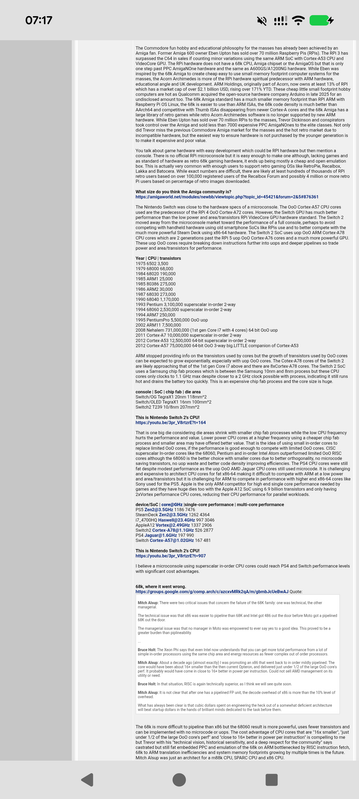
The Commodore fun hobby and educational philosophy for the masses has already been achieved by an Amiga fan. Former Amiga 600 owner Eben Upton has sold over 70 million Raspberry Pis (RPis). The RPi 3 has surpassed the C64 in sales if counting minor variations using the same ARM SoC with Cortex-A53 CPU and VideoCore GPU. The RPi hardware does not have a 68k CPU, Amiga chipset or the AmigaOS but that is only one step past PPC AmigaNOne hardware and the same as A600GS/A1200NG hardware. While Eben was inspired by the 68k Amiga to create cheap easy to use small memory footprint computer systems for the masses, the Acorn Archimedes is more of the RPi hardware spiritual predecessor with ARM hardware, educational angle and UK development. ARM Holdings, originally part of Acorn, now owns at least 13% of RPI which has a market cap of over $2.1 billion USD, rising over 171% YTD. These cheap little small footprint hobby computers are hot as Qualcomm acquired the open-source hardware company Arduino in late 2025 for an undisclosed amount too. The 68k Amiga standard has a much smaller memory footprint than RPI ARM with Raspberry Pi OS Linux, the 68k is easier to use than ARM ISAs, the 68k code density is much better than AArch64 and competitive with Thumb ISAs disappearing from newer Cortex-A cores and the 68k Amiga has a large library of retro games while retro Acorn Archimedes software is no longer supported by new ARM hardware. While Eben Upton has sold over 70 million RPis to the masses, Trevor Dickinson and conspirators took control over the Amiga and sold less than 7000 expensive PPC AmigaNOnes to the elite classes. Not only did Trevor miss the previous Commodore Amiga market for the masses and the hot retro market due to incompatible hardware, but the easiest way to ensure hardware is not purchased by the younger generation is to make it expensive and poor value.
You talk about game hardware with easy development which could be RPI hardware but then mention a console. There is no official RPi microconsole but it is easy enough to make one although, lacking games and as standard of hardware as retro 68k gaming hardware, it ends up being mostly a cheap and open emulation box. This is actually very common with enough users to support retro gaming OSs like RetroPie, Recalbox, Lakka and Batocera. While exact numbers are difficult, there are likely at least hundreds of thousands of RPi retro users based on over 100,000 registered users of the Recalbox Forum and possibly 4 million or more retro Pi users based on percentage of retro images downloaded.
What size do you think the Amiga community is?
https://amigaworld.net/modules/newbb/viewtopic.php?topic_id=45421&forum=2&5#876361
The Nintendo Switch was close to the hardware specs of a microconsole. The OoO Cortex-A57 CPU cores used are the predecessor of the RPi 4 OoO Cortex-A72 cores. However, the Switch GPU has much better performance than the low power and area/transistors RPi VideoCore GPU hardware standard. The Switch 2 moved away from the microconsole market toward the performance of a full console, perhaps to avoid competing with handheld hardware using old smartphone SoCs like RPis use and to better compete with the much more powerful Steam Deck using x86-64 hardware. The Switch 2 SoC uses uop OoO ARM Cortex-A78 CPU cores which are 2 generations past the RPi 5 uop OoO Cortex-A76 cores and a much more powerful GPU. These uop OoO cores require breaking down instructions further into uops and deeper pipelines so trade power and area/transistors for performance.
Year | CPU | transistors
1975 6502 3,500
1979 68000 68,000
1984 68020 190,000
1985 ARM1 25,000
1985 80386 275,000
1986 ARM2 30,000
1987 68030 273,000
1990 68040 1,170,000
1993 Pentium 3,100,000 superscalar in-order 2-way
1994 68060 2,530,000 superscalar in-order 2-way
1994 ARM7 250,000
1995 PentiumPro 5,500,000 OoO uop
2002 ARM11 7,500,000
2008 Nehalem 731,000,000 (1st gen Core i7 with 4 cores) 64 bit OoO uop
2011 Cortex-A7 10,000,000 superscalar in-order 2-way
2012 Cortex-A53 12,500,000 64-bit superscalar in-order 2-way
2012 Cortex-A57 75,000,000 64-bit OoO 3-way big.LITTLE companion of Cortex-A53
ARM stopped providing info on the transistors used by cores but the growth of transistors used by OoO cores can be expected to grow exponentially, especially with uop OoO cores. The Cotex-A78 cores of the Switch 2 are likely approaching that of the 1st gen Core i7 above and there are 8xCortex-A78 cores. The Switch 2 SoC uses a Samsung chip fab process which is between the Samsung 10nm and 8nm process but these CPU cores only clocks to 1.1 GHz max despite closer to a 2 GHz clock possible with process, indicating it still runs hot and drains the battery too quickly. This is an expensive chip fab process and the core size is huge.
console | SoC | chip fab | die area
Switch/OG TegraX1 20nm 118mm^2
Switch/OLED TegraX1 16nm 100mm^2
Switch2 T239 10/8nm 207mm^2
This is Nintendo Switch 2's CPU!
https://youtu.be/3pr_V8rtzrE?t=164
That is one big die considering die areas shrink with smaller chip fab processes while the low CPU frequency hurts the performance and value. Lower power CPU cores at a higher frequency using a cheaper chip fab process and smaller area may have offered better value. That is the idea of using small in-order cores to replace limited OoO cores, if the performance is good enough to compete with limited OoO cores. CISC superscalar In-order cores like the 68060, Pentium and in-order Intel Atom outperformed limited OoO RISC cores although the 68060 is the better choice with smaller cores due to better orthogonality, no microcode saving transistors, no uop waste and better code density improving efficiencies. The PS4 CPU cores were still fat despite modest performance as the uop OoO AMD Jaguar CPU cores still used microcode. It is challenging and expensive to architect CPU cores for fat x86-64 making it difficult to compete with ARM at a low power and area/transistors but it is challenging for ARM to compete in performance with higher end x86-64 cores like Sony used for the PS5. Apple is the only ARM competitor for high end single core performance needed by games and they have huge dies too with the Apple A12 SoC using 6.9 billion transistors and only having 2xVortex performance CPU cores, reducing their CPU performance for parallel workloads.
device/SoC | core@GHz |single-core performance | multi-core performance
PS5 Zen2@3.5GHz 1186 7476
SteamDeck Zen2@3.5GHz 1262 4364
i7_4700HQ Haswell@2.34GHz 997 3046
AppleA12 Vortex@2.49GHz 1337 2906
Switch2 Cortex-A78@1.1GHz 526 2877
PS4 Jaguar@1.6GHz 197 990
Switch Cortex-A57@1.02GHz 167 481
This is Nintendo Switch 2's CPU!
https://youtu.be/3pr_V8rtzrE?t=907
I believe a microconsole using superscalar in-order CPU cores could reach PS4 and Switch performance levels with significant cost advantages.
68k, where it went wrong.
https://groups.google.com/g/comp.arch/c/azcxvMRk2qA/m/gbmbJcUeBwAJ Quote:
Mitch Alsup: There were two critical issues that concern the failure of the 68K family: one was technical, the other managerial.
The technical issue was that x86 was easier to pipeline than 68K and Intel got 486 out the door before Moto got a pipelined 68K out the door.
The managerial issue was that no manager in Moto was empowered to ever say yes to a good idea. This proved to be a greater burden than piplineability.
...
Bruce Holt: The Xeon Phi says that even Intel now understands that you can get more total performance from a lot of simple in-order processors using the same chip area and energy resources as fewer complex out of order processors.
Mitch Alsup: About a decade ago (almost exactly) I was promoting an x86 that went back to in order mildly pipelined. The core would have been about 16× smaller than the then current Opteron, and delivered just under 1/2 of the large OoO core's perf. It probably would have come in close to 16× better in power per instruction. Could not sell AMD management on its utility or need.
Bruce Holt: In that situation, RISC is again technically superior, as I think we will see quite soon.
Mitch Alsup: It is not clear that after one has a pipelined FP unit, the decode overhead of x86 is more than the 10% level of overhead.
What has always been clear is that cubic dollars spent on engineering the heck out of a somewhat deficient architecture will beat startup dollars in the hands of brilliant minds dedicated to the task before them.
|
The 68k is more difficult to pipeline than x86 but the 68060 result is more powerful, uses fewer transistors and can be implemented with no microcode or uops. The cost advantage of CPU cores that are "16x smaller", "just under 1/2 of the large OoO core's perf" and "close to 16× better in power per instruction" is compelling to me but Trevor with his "technical vision, historical sensitivity, and a deep respect for the community" says castrated but still fat embedded PPC and emulation of the 68k on ARM bottlenecked by RISC instruction fetch, 68k to ARM translation inefficiencies and system memory footprints growing by multiple times is the future. Mitch Alsup was just an architect for a m88k CPU, SPARC CPU and x86 CPU.
There is no open console let alone open miniconsole. While the Nintendo Switch was close in hardware to a miniconsole, Nintendo has been one of the most closed and protective console and gaming businesses while Sony and Microsoft are not much better. The Amiga CD32 was significant as a more open and expandable console and perhaps the first console with an OS, unless considering the CDTV a console which I would not. This allowed the CD32 to be expanded into a full Amiga computer that could be used for general purpose use including development and supports 68060 accelerators meaning a modernized 68060 could be ~10,000 to ~20,000 time better performance while retaining good compatibility. The more open competitors today are RPi unofficial console hardware, mostly using emulation, and MiSTer hardware using FPGA tech for more accurate simulation but at a much higher price, mostly because high performance CPUs require expensive FPGAs. Fortunately, we have "a maker, an entrepreneur, someone who had the courage to push modern hardware based on open standards while keeping the spirit of the Amiga alive without betraying its essence" and his approach "is ethical, purposeful development, the kind that moves the needle of the Amiga ecosystem one step forward." The A-EonKit A600GS and A1200NG are the ultimate in open hardware and software, efficiency and RPi competitiveness after all. They should be renamed to Amiga Ultimate to stand by the Commodore C64 Ultimate. Are they not everything you asked for and, if not, why not?
Last edited by matthey on 31-May-2026 at 04:39 AM.
Last edited by matthey on 30-May-2026 at 05:42 PM.
|
| | Status: Offline |
| | MEGA_RJ_MICAL
| |
Re: When computers were fun... -- and could be again??
Posted on 31-May-2026 3:03:46
| | [ #59 ] |
| |
|
Super Member
|
Joined: 13-Dec-2019
Posts: 1471
From: AMIGAWORLD.NET WAS ORIGINALLY FOUNDED BY DAVID DOYLE | | |
|
| Tell me your life is an empty husk of loneliness and lack of purpose
without telling me your life is an empty husk of loneliness and lack of purpose
 _________________
I HAVE ABS OF STEEL
--
CAN YOU SEE ME? CAN YOU HEAR ME? OK FOR WORK |
| | Status: Offline |
| | jingof
| |
Re: When computers were fun... -- and could be again??
Posted on 31-May-2026 6:30:58
| | [ #60 ] |
| |
|
Cult Member
|
Joined: 8-May-2007
Posts: 516
From: Jingo Fet is from "A Galaxy Far, Far Away" | | |
|
| @matthey
Thanks for your detailed and thoughtful reply. I must admit, part of your reply dove deeply into details of hardware specification that I felt were unrelated to the OP. For example, I'll concede that:
Quote:
in-order Intel Atom outperformed limited OoO RISC cores although the 68060 is the better choice with smaller cores due to better orthogonality
|
But I'm not quite sure how that relates to the point I was making. Of course, I could be missing the relevance - if you want to clarify, I'm happy to take the correction.
That said, your point about the Raspberry Pi is an excellent one, and it's the part of your reply I want to engage head-on rather than wave away. You're right: Upton got educational computing to the masses at a scale the Amiga never approached, and if we're being honest about lineage, the Acorn Archimedes — ARM, UK, education-first — is the truer spiritual ancestor of what I was describing than the Amiga is. Credit where it's due. 70 million units is the dream made real.
But I'd argue the Pi proves my diagnosis while sidestepping my actual point. A Pi is a full Linux box, which means it carries the exact "ocean of terms and technologies" problem from my original post — just at $50 instead of $500. It's a magnificent thing for the kid who already wants to tinker, or who has a parent or a Code Club to scaffold them. What it isn't is the bounded, get-your-head-around-it whole the C-64 was, where the machine you turned on and the machine you programmed were the same machine — no install step, no OS to manage, no distro to choose. The Pi gives you everything, and therefore gives you no edges. A small cheap PC is not a small world.
And here's the practical problem I keep coming back to, because it's the one nobody in the Pi camp seems to weight properly: there is no turn-key Pi. The openness everyone celebrates means somebody has to assemble the experience — pick the OS, flash the card, install and configure the learning environment, keep it running, fix it when it breaks. For a hobbyist, that is the fun. For the parent of an 8-year-old, it's a wall they will never get over — so the kid never gets the machine. The flexibility quietly relocates all the work onto the one person least equipped and least motivated to do it. The C-64 demanded none of that: you plugged it in, and the computer that booted was the one the kid programmed. "Capable but requires assembly" and "turn-key for a non-technical parent" are simply different products, and only the second one ever actually reaches the child.
The RetroPie and Recalbox numbers, IMO, make my case for me. Hand people an open, hackable, infinitely capable machine, and the overwhelming majority turn it into an emulation box to play our old games rather than make new ones. The creativity affordance was right there, free, and consumption still won. Which tells me the missing ingredient was never hardware capability or price. It was a designed, bounded, opinionated environment that makes making the path of least resistance — the thing a bare Pi specifically refuses to be.
And here's the part that I think actually makes the case rather than undercutting it: this turn-key kids' product has been built before, and the way it failed is the most useful thing in this whole discussion. Kano did almost exactly what I'm describing — Raspberry Pi inside, boots straight into a child's coding OS, reviewers literally said "buy it and give it to your child" — and it raised tens of millions and got into schools across multiple continents before it ran out of road. That's not evidence the market isn't there; it's evidence the demand and the design were both real. What it lacked was a reason a family had to buy it instead of a Switch — it was, in the end, a nicer way to learn Scratch, competing against free. PocketCHIP had the same shape: lovely, preloaded, and with no compelling reason to exist over the alternatives. So I'm not calling for a repeat of those. I'm saying they proved the hard parts are solvable and the appetite is real — and that the piece they were missing is the piece that didn't exist yet.
That missing piece is Max — and not as a gimmick. Schools right now are panicking about exactly the wrong thing AI is doing to kids: hand the assignment to a chatbot, paste the output, learn nothing. A device built around an AI whose entire purpose is to refuse to give the answer — that teaches a kid to arrive at it themselves, in coding and in schoolwork — is selling something parents and educators are actively anxious about today and can't get anywhere else. That's the reason-to-exist Kano never had. The box was always buildable. What's new is that there's finally something in it worth more to a worried parent than another game console.
Which finally brings me back to the A600GS and A1200NG. No, those aren't what I asked for, and the reason is the same reason the bare Pi isn't. They're aimed at us — people who already know what Linux or an Amiga is and feel something when the boot chime hits. A box that needs you to already love the Amiga to want it cannot, by definition, be the thing that hands the spirit to an 11-year-old who's never heard of one. That's not a knock on the engineering, which I respect. It's that "open hardware for the faithful" and "a bounded creative world for a kid who'll never care about our nostalgia" are orthogonal goals — and only one of them was what the OP was about.
Last edited by jingof on 31-May-2026 at 06:43 AM.
Last edited by jingof on 31-May-2026 at 06:40 AM.
Last edited by jingof on 31-May-2026 at 06:35 AM.
_________________
Vic-20, C-64, C-128
Amiga 1000, 3000
AmigaOne X1000 |
| | Status: Offline |
| |
|
|
|
[ home ][ about us ][ privacy ]
[ forums ][ classifieds ]
[ links ][ news archive ]
[ link to us ][ user account ]
|


